Tag Archives: frank lloyd wright

Frank Lloyd Wright’s Fontana Boathouse

Buffalo, New York


Fontana Boathouse exterior

In 1905, University of Wisconsin oarsman & Wright family friend, Cudworth Bye, asked Frank Lloyd Wright to design a new boathouse for the Badger crew team on the Yahara River. FLW quickly agreed, and the boathouse was designed, but never built. It was briefly given new life in Wright’s Wasmuth Profile, which was a catalog of work FLW considered his best. Unfortunately, the design was filed away once again.

It wasn’t until several decades later, that a Buffalo, NY group came across the design, and purchased the rights. In 2007, the boathouse Frank Lloyd Wright designed a century earlier opened on the bank of the Niagara River.


The Canisius side of the boathouse

The Fontana Boathouse is home to the West Side Rowing Club. Luckily, for the Frozen Foursome, it is also home to Canisius College Crew. We were checking out the boathouse exterior, when we met Kerri Brace, the head coach of the Canisius Rowing program. She was incredibly kind, and offered us a brief tour of the inside of the boathouse.

The boathouse was dedicated as The Charlie and Marie Fontana Boathouse, in honor of the long time rower and coach at the West Side Rowing Club, and his wife.

Post script: The Golden Griffins rowing team finished sixth at the MAAC Championship, in Coach Kerri Brace’s second year at the helm. Junior Co-captain Emma Vicaretti was named to the All-MAAC first team, and senior Bridget Lillis earned All-MAAC second team honors. Eight members of the team were named to the MAAC All-Academic Team.

Go Griffs


Pierce-Arrow Museum

Buffalo, New York


Exterior to the Pierce-Arrow showroom

Officially known as the Buffalo Transportation Pierce-Arrow Museum, the museum has quite the collection of classic cars, trucks, motorcycles and bicycles, plus one filling station. The museum organized as a non-profit in 1997, and moved into their current location, a former Mack Truck showroom, in 2001.

George Pierce started out making ice chests & birdcages, progressing into bicycles. In 1901, the Pierce Company opened a large factory in Buffalo’s Canalside district. In 1903, the company produced a two-cylinder car called The Arrow. The following year, The Great Arrow came on the market. This car was larger and more luxurious than its predecessor, and it was powered by a four-cylinder engine. In 1905, The Great Arrow won the Glidden Tour, which was an endurance run that determined the most reliable car on the market. By 1909, President Taft had made two Pierce-Arrows the official cars of the White House.

Here are a few of the vehicles I enjoyed checking out at the P-A Museum:


1909 Thomas Flyer 6-40 Flyabout

The Thomas Flyer was also manufactured in Buffalo, NY until 1913. This little Flyabout, was a 5 passenger, powered by a six-cylinder/267 cubic inch engine, coupled to a three speed transmission. The motor put out a whopping 40 HP. In 1908, a Thomas Flyer won the New York to Paris Race.
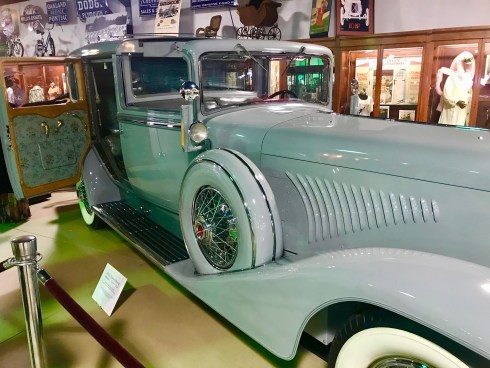

1932 Duesenberg Model J Town Car

This particular Duesenberg was the most expensive ever produced. Custom built for the Countess Anna Ingraham, the car cost $25,000 in 1932.


The Duesenberg


$2.50 down buys you a Harley?

Automatically, I thought $250.00 down, but no, it was $2.50. I asked for clarification.


1940 Lincoln

Frank Lloyd Wright ordered one of these Lincolns in 1940. He proclaimed it the most beautiful car ever designed. Hard to argue with FLW.


1934 Pierce-Arrow Model 1248A

The 1934 Pierce-Arrow was proclaimed an “All Weather Town Brougham”, with its canvas roll up, and solid leather roof for the chauffeur. This model had an aluminum body, and was powered by a V-12 engine. There was only one of these made. It was owned by opera diva Ms. Mary Garden, whose father had the world’s largest Pierce-Arrow dealership.


Pierce-Arrow’s 1933 Silver Arrow; Designed as a car, that can not be ignored

My favorite car in the collection: the 1933 Silver Arrow. They say this car “caused an absolute sensation” when it was introduced in 1933. Powered by the V-12 engine, the Silver Arrow could hit 115mph. Five of these cars were built, only three remain in existence today.


The ’33 Silver Arrow

What a sharp, futuristic looking car for 1933.


Joseph Seagram & Sons’ Pierce-Arrow delivery truck


The Frank Lloyd Wright designed filling station

In 1927, Frank Lloyd Wright designed a filling station that was to be built in downtown Buffalo, on the corners of Michigan Avenue and Cherry Street. The station was never built.

Fast forward to 2002: The Pierce-Arrow Museum, working off of original drawings, create the copper, work of art within the large showroom. Wright called his station design “an ornament to the pavement”. The station is quite the structure. It contains a second story observation room, complete with a fireplace and restrooms. The observation room was meant as a comfortable place for patrons to wait for their vehicle while it was being serviced. It was also to include an attendants quarters, also equipped with a fireplace. The gas distribution system was gravity fed. The two 45 foot, copper poles holding the station’s marque, were described as “totems” by Wright. It would have been an impressive filling station, if it had been built. As it stands, its an impressive & unique addition to the museum.

The museum has several volunteers with a wealth of information about the items on display. I found them more than willing to share their knowledge. Admission for an adult was $10.


Fasbender Medical Clinic

The Fasbender Clinic building was designed by Frank Lloyd Wright in 1957. It is located along Pine Street in Hastings, Minnesota. The building is listed on the National Register of Historic Places, and is currently a Edward Jones financial office.

The Fasbender Clinic is known for its copper roof, which wraps around the building, and extends almost to the ground in several places.


Frank Lloyd Wright Home & Studio

While in Chicago, we visited the Frank Lloyd House & Studio, which is located on Chicago Avenue in Oak Park. FLW built the home in 1889, using a loan of $5000 from his employer Louis Sullivan, to purchase the property and start construction. The home received an extensive remodel and addition in 1895, and the Studio was added to the property in 1898. Both the Home & Studio were declared a National Historic Landmark in 1976.


Mural and skylight in the children’s playroom

The FLW Preservation Trust currently owns the home and studio. They have restored the property to it’s condition in 1909, when the Wright’s lived there, raising six children.


Lighting, both natural and electric, in the playroom

The home has made use of a lot of stained glass, skylights and indirect natural lighting. Pictures were hard to come by, while on a tour. Our group was 15 strong, which is a full tour group. Many of the rooms, and hallways are quite small, but then open into larger rooms with tall ceilings. It was a challenge to take photos without including members of the tour.

As much as I enjoyed the home, I think I liked the studio even more. It is a wonderful workplace. Two sections of the studio are octagon shaped rooms, connected by the front entry room. FLW’s private office was octagonal, as was the two story room, where the designers and craftsmen worked on projects. If you go, look for the structural chains in the main design room.


The Studio, as seen from across Chicago Ave

The Studio must have been a major presence on Chicago Avenue at the time it was built. No doubt, it offered some wonderful, free advertising. If someone wanted to build a unique and “out-of-the-box” home, a trip down Chicago Avenue would tell you that FLW was worth contacting.

The guided tour lasts about an hour, and is well worth the time, if you are wandering around Oak Park, and looking for something to do.