Tag Archives: writing

Liberating Literature

Banned Books Week is celebrating its 30th Anniversary. In honor of this week’s event, here is a list of the Top Ten Most Challenged Books of 2011:

1. “ttyl; ttfn; l8r, g8r” (series), by Lauren Myracle

2. “The Color of Earth” (series), by Kim Dong Hwa

3. “The Hunger Games” trilogy, by Suzanne Collins

4. “My Mom’s Having A Baby! A Kid’s Month-by-Month Guide to Pregnancy”, by Dori Hillestad Butler

5. “The Absolutely True Diary of a Part-Time Indian”, by Sherman Alexie

6. “Alice” (series), by Phyllis Reynolds Naylor

7. “Brave New World”, by Aldous Huxley

8. “What My Mother Doesn’t Know”, by Sonya Sones

9. “Gossip Girl” (series), by Cecily Von Ziegesar

10. “To Kill a Mockingbird”, by Harper Lee

No Twain, Steinbeck or even J.K. Rowling this time, but after all these years, “To Kill A Mockingbird” still makes the list… My best wishes to Harper Lee…
I’m betting that that the odds are pretty good that “Fifty Shades of Grey” makes next year’s list.


Seriously?

The iTypewriter?

One can now hear the classic, tapping sound of a manual typewriter when shooting off emails to friends on your iPad.

I have to admit that I find the idea intriguing, but I’ll stick with my Underwood. Afterall, the whole point of an old typewriter is to feel the impact on your fingertip when you pound the key hard enough to send the period through the paper. Without that, one might as well be driving an automatic.

What I’m really waiting for is the iTurntable. When that spins out into the market, I’ll be all over that.


The ‘Oxford & Cambridge’ Question

‘Cambridge and Oxford’ on the Stillwell Road, Burma.

A while back, Alex asked me a question on why these two Rovers were called Oxford & Cambridge. I was then scolded by another reader for not giving more information in that post on “The Oxford & Cambridge Far Eastern Expedition”.
Well, I was traveling without the laptop, and uploading posts through the phone is simply a pain in the arse.

In 1955 six Oxford & Cambridge students set off overland from London for Singapore. It turned out that only one student, Nigel Newbery, was from Oxford, but the name of the expedition stuck and the two Land Rovers were then referred to as “Oxford” and “Cambridge”. In fact, they were painted Cambridge blue and the darker blue of Oxford.

The expedition left Hyde Park and crossed the English Channel to France. From there they traveled through Monaco, Germany, Austria, Jugoslavia, Greece, Turkey, Syria, Iraq, Iran, Afghanistan, Pakistan, India, Nepal, Burma, Thailand, Malaya and Singapore. The trek to Singapore took 6 months and 6 days, traversing 18,000 miles.


Beast or God

“He who is unable to live in society, or who has no need because he is sufficient for himself, must be either a beast or a god.”
—Aristotle


• Dedicated urbanites “know” beyond shadow of doubt – because doubt never raises its disturbing head – that civilization is the real world: you only “escape” to wilderness. When you’re out and away and immmersed, you “know” the obverse: the wilderness world is real, the human world a superimposed facade… The controversy is, of course, spurious. Neither view can stand alone. Both worlds are real. But the wilderness world is certainly older and will almost certainly last longer. Besides, the second view seems far healthier for a human to embrace.

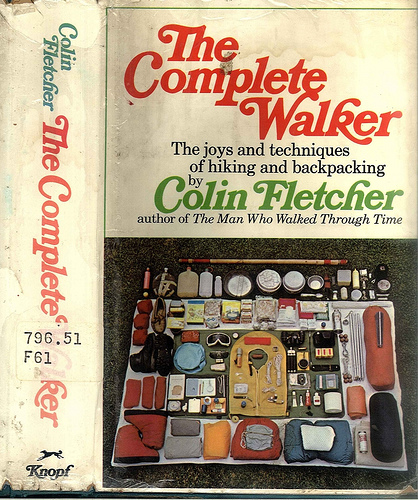
Colin Fletcher — River


Happy Halloween —

—Go Out & Hug a Pagan

A pleasing land of drowsy head it was,
Of dreams that wave before the half-shut eye;
And of gay castles in the clouds that pass,
Forever flushing round a summer sky.
CASTLE OF INDOLENCE.


\

“Write drunk; edit sober.” — Hemingway


Getting The Itch

“Under the big oak trees of my place at Sag Harbor sat Rocinante, handsome and self-contained, and neighbors came to visit, some neighbors we didn’t even know we had. I saw in their eyes something I was to see over and over in every part of the nation – a burning desire to go, to move, to get under way, anyplace, away from Here. They spoke quietly of how they wanted to go someday, to move about, free and unanchored, not toward something but away from something. I saw this look and heard this yearning everywhere in every state I visited. Nearly every American hungers to move. One small boy about thirteen years old came back every day. He stood apart shyly and looked at Rocinante; he peered in the door, even lay on the ground and studied the heavy-duty springs. He was a silent, ubiquitous small boy. He even came at night to stare at Rocinante. After a week he could stand it no longer. His words wrestled their way hellbent through his shyness. He said, ‘If you’ll take me with you, why, I’ll do anything. I’ll cook, I’ll wash all the dishes, and do all the work and I’ll take care of you.’

Unfortunately for me I knew his longing. ‘I wish I could,’ I said. ‘But the school board and your parents and lots of others say I can’t.’

‘I’ll do anything,’ he said. And I believe he would. I don’t think he ever gave up until I drove away without him. He had the dream I’ve had all my life, and there is no cure.”

—John Steinbeck
“Travels With Charley”

That way lies madness.


John Haines

“The physical domain of the country had its counterpart in me. The trails I made led outward into the hills and swamps, but they led inward also. And from the study of things underfoot, and from reading and thinking, came a kind of exploration, myself and the land. In time the two became one in my mind. With the gathering force of an essential thing realizing itself out of early ground, I faced in myself a passionate and tenacious longing—to put away all thought forever, and all the trouble it brings, all but the nearest desire, direct and searching. To take the trail and not look back. Whether on foot, on snowshoes or by sled, into the summer hills and their late freezing shadows—a high blaze, a runner track in the snow would show where I had gone. Let the rest of mankind find me if it could.”
— John Haines

John Haines died in Fairbanks this spring when I was off traveling. I had no idea until today. I had heard of Haines ever since I landed in Alaska, but I hadn’t read his work until a good friend gave me a copy of “The Stars, The Snow, The Fire”. I’ve been searching out his work ever since. The man, more than any other writer I have read, captured the essence of Alaska.
Haines drove up to Alaska in 1947 and bought a homestead out towards Delta Junction. He built his cabin by hand out of salvaged lumber and homesteaded. According to Haines, he came to Alaska as a painter, but when his paint kept freezing, he started to write instead. He hunted, trapped, , mushed dogs, chopped firewood, observed and wrote. Man, did he ever write. Another Alaska writer, Dan O’Neill has called Haines, “the best poet, writer, and author Alaska has ever produced.”

Former college professor John Kooistra, a longtime friend of Haines, stated that Jack London and Robert Service “were essentially tourists” compared with Haines. “This is poetry of a different level. He was a cantankerous, insufferable, unbendable old bastard but he was a damn good writer. He is Alaska’s best writer. He was a standout.” He was an Alaskan.

John Haines was 86. He will be deeply missed.

“By candle or firelight
your face still holds
a mystery that once
filled caves with the color
of unforgettable beasts.”
–“Winter Light” by John Haines


Mesquite

7:54pm
I made it back to camp as the clouds blew in, obscuring the snowcapped peaks. I flipped open the tent, sitting below it to keep out of the weather. I had planned on a hike through a canyon nearby, but I could see the rain falling on the other side of the valley, so I started to write a letter instead.
Soon the gusts were swirling and dust covered the sheet of paper. I kept writing until the dust became a white ball on the tip of my pen. When the rain drops started to mix with the dust, I moved the chair into the rear of The Rover to watch the desert storm.
I continued to write, and the rain continued to fall. I mixed a cocktail, ate some cheese & crackers, and played some BB King. Some people off in the distance worked on putting up a large dome tent with a nylon screen roof. They call that a skylight, and they always leak. Twenty minutes later, and the tent was barely upright and the rain fly had yet to be deployed. Hopefully, they had cots to sleep on.
BB King morphed into John Prine, and it was time to cook dinner. Which I did from my chair in the truck. The campground host came to check on my credentials, and John Prine had become Miles Davis. The words continued to flow, so I wrote as the rain continued to fall in the desert.