Tag Archives: new york

Theodore Roosevelt Inaugural Historic Site


The Wilcox House from the street

The site in downtown Buffalo, was once the Buffalo Barracks compound. With tensions between the U.S. and Canada back in 1839, a military post was built here. One building remains from the post, which is the oldest building within the historic site. By 1845, the military post had been abandoned, and the property went into private hands, eventually being given to Ansley Wilcox by his father in law.


Side view of the Wilcox House

In 1901, Buffalo was host to the Pan-American Exposition. While attending the exposition, President William McKinley was shot twice in the abdomen by anarchist Leon Czolgosz. Cabinet members rushed to Buffalo, but McKinley appeared to improve, so the cabinet dispersed, and Vice President Theodore Roosevelt went camping in the Adirondacks. McKinley’s condition worsened due to only one of the two bullets being found. Oddly enough, a primitive X-Ray machine was on exhibit at the Pan-American Exposition, but it was never used on the president. Roosevelt and the Cabinet were summoned once again. President McKinley would not recover.


Roosevelt and Pan-American Exposition display

Roosevelt would arrive back in Buffalo after McKinley had already died. Cabinet members felt that Roosevelt should be sworn in immediately. The Wilcox House was determined to be an appropriate site, so Theodore Roosevelt was inaugurated on September 14, 1901 within the Wilcox House, Buffalo, New York.


The desk where TR wrote his inaugural address


The Wilcox library, where Roosevelt was sworn in as President of the U.S.

The Wilcoxes lived in the home until their deaths in the 1930’s. The home was sold at public auction, and was converted into a restaurant. The restaurant closed in 1961, and the home was declared a National Historic Site in 1966.


Pierce-Arrow Museum

Buffalo, New York


Exterior to the Pierce-Arrow showroom

Officially known as the Buffalo Transportation Pierce-Arrow Museum, the museum has quite the collection of classic cars, trucks, motorcycles and bicycles, plus one filling station. The museum organized as a non-profit in 1997, and moved into their current location, a former Mack Truck showroom, in 2001.

George Pierce started out making ice chests & birdcages, progressing into bicycles. In 1901, the Pierce Company opened a large factory in Buffalo’s Canalside district. In 1903, the company produced a two-cylinder car called The Arrow. The following year, The Great Arrow came on the market. This car was larger and more luxurious than its predecessor, and it was powered by a four-cylinder engine. In 1905, The Great Arrow won the Glidden Tour, which was an endurance run that determined the most reliable car on the market. By 1909, President Taft had made two Pierce-Arrows the official cars of the White House.

Here are a few of the vehicles I enjoyed checking out at the P-A Museum:


1909 Thomas Flyer 6-40 Flyabout

The Thomas Flyer was also manufactured in Buffalo, NY until 1913. This little Flyabout, was a 5 passenger, powered by a six-cylinder/267 cubic inch engine, coupled to a three speed transmission. The motor put out a whopping 40 HP. In 1908, a Thomas Flyer won the New York to Paris Race.
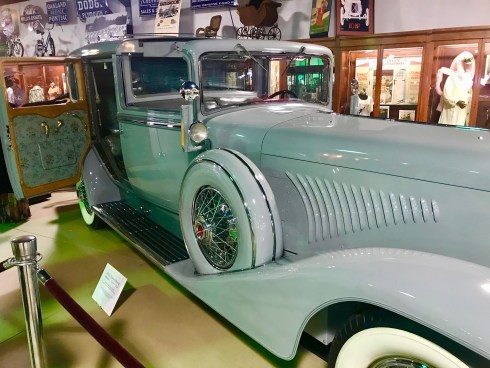

1932 Duesenberg Model J Town Car

This particular Duesenberg was the most expensive ever produced. Custom built for the Countess Anna Ingraham, the car cost $25,000 in 1932.


The Duesenberg


$2.50 down buys you a Harley?

Automatically, I thought $250.00 down, but no, it was $2.50. I asked for clarification.


1940 Lincoln

Frank Lloyd Wright ordered one of these Lincolns in 1940. He proclaimed it the most beautiful car ever designed. Hard to argue with FLW.


1934 Pierce-Arrow Model 1248A

The 1934 Pierce-Arrow was proclaimed an “All Weather Town Brougham”, with its canvas roll up, and solid leather roof for the chauffeur. This model had an aluminum body, and was powered by a V-12 engine. There was only one of these made. It was owned by opera diva Ms. Mary Garden, whose father had the world’s largest Pierce-Arrow dealership.


Pierce-Arrow’s 1933 Silver Arrow; Designed as a car, that can not be ignored

My favorite car in the collection: the 1933 Silver Arrow. They say this car “caused an absolute sensation” when it was introduced in 1933. Powered by the V-12 engine, the Silver Arrow could hit 115mph. Five of these cars were built, only three remain in existence today.


The ’33 Silver Arrow

What a sharp, futuristic looking car for 1933.


Joseph Seagram & Sons’ Pierce-Arrow delivery truck


The Frank Lloyd Wright designed filling station

In 1927, Frank Lloyd Wright designed a filling station that was to be built in downtown Buffalo, on the corners of Michigan Avenue and Cherry Street. The station was never built.

Fast forward to 2002: The Pierce-Arrow Museum, working off of original drawings, create the copper, work of art within the large showroom. Wright called his station design “an ornament to the pavement”. The station is quite the structure. It contains a second story observation room, complete with a fireplace and restrooms. The observation room was meant as a comfortable place for patrons to wait for their vehicle while it was being serviced. It was also to include an attendants quarters, also equipped with a fireplace. The gas distribution system was gravity fed. The two 45 foot, copper poles holding the station’s marque, were described as “totems” by Wright. It would have been an impressive filling station, if it had been built. As it stands, its an impressive & unique addition to the museum.

The museum has several volunteers with a wealth of information about the items on display. I found them more than willing to share their knowledge. Admission for an adult was $10.


BCT in B&W


One entrance to Buffalo Central Terminal


To Station: Don’t forget to pet the buffalo as you go by


Tickets. New York Central’s Cleveland Limited departs at 4:40am


Buffalo Central Terminal Revisited

A few more pictures from our visit to Buffalo Central Terminal:


Larkinville


Larkin Center of Commerce building

The Larkin neighborhood of Buffalo, NY came into its own in 1827, with the construction of the Hydraulic Canal. It was Buffalo’s first source of industrial waterpower. By 1832, the area was a booming mill district, with everything powered by “The Hydraulics”.

In 1876, John Larkin set up his soap making business on Seneca Street. JD Larkin & Co. became a pioneer in direct sales from the manufacturer to the consumer. The Larkin Idea became the company’s marketing principle, by 1885.


The Larkin Soap Co.

Today, the old buildings and warehouses are being renovated into businesses and lofts. The area is obviously thriving with the new development. The Frozen Foursome spent an afternoon prior to the championship game, exploring the revitalized Larkinville neighborhood. The trip included a visit to the Flying Bison Brewing Company.


Buffalo Central Terminal


Looking up at the Buffalo Central Terminal

Buffalo Central Terminal, built by the New York Central Railroad, opened in 1929, just months before the stock market crash of October. The art deco building was designed to handle over 200 trains and 10,000 passengers daily.

Station visitors were originally greeted by a stuffed American bison. Passengers, including thousands of WWII soldiers, rubbed their hands through the fur, causing the large buffalo to go bald. It was replaced by a bronze statue, which was destroyed by an eventual owner of the terminal. A bronze recasting using the original molds, can be found outside the football stadium on the University of Buffalo North Campus. The current statue in the station, is a fiberglass replica.

Buffalo Central Terminal saw active train service from 1929 – 1979. In addition to New York Central, the Canadian National Railway, Pennsylvania Railroad, and Toronto, Hamilton & Buffalo Railway also serviced BCT. The terminal saw its peak during World War II.

While touring about Buffalo, the Frozen Foursome received an unexpected invitation to tour the main concourse of Buffalo Central Terminal. As a perfect example, of “it doesn’t hurt to ask”, one quick question had us in the door, and once it became apparent that we were in no hurry to leave, an additional invite to explore further inside was offered.

All of us were excited to see inside the abandoned terminal, but it was far more personal for The Curator. His father was an engineer for New York Central, and he remembered running throughout the concourse when he visited Central Terminal with his dad and siblings.

BCT is a beautiful terminal, and must have been something very special in its day. It is currently owned by the Central Terminal Restoration Corp., whose volunteers we met and talked with during our visit. I reminded one volunteer that Union Depot in Saint Paul, Minnesota has been brought back to life and train service restored. There is certainly hope for Buffalo Central Terminal, although it’s a damn shame that the building has suffered such neglect.

BCT opened with a Western Union office, a restaurant with dining room and lunch counter, a coffee shop, soda fountain, and, of course, a street car lobby.

Central Terminal is located 2.5 miles from downtown Buffalo. The current Amtrak station, is a tiny building a bit closer to downtown. Throughout its history, Buffalo Central Terminal was always larger than needed, but hopefully the CTRC will be able to repurpose BCT now that Buffalo itself is seeing a revitalization.


Knocking on Fortress Door


Devil’s Hole Stairway


The Niagara


The Hotel Niagara, Niagara Falls, New York

The Niagara, a 200 room hotel, opened in 1925. It is located 1/4 mile from Horseshoe Falls. The hotel has been shuttered since 2007, although it was placed on the National Register of Historic Places in 2008.


New York Central