After a year of planning, three photographers came to Fairbanks to attempt something never accomplished. They would try to “capture cinema-quality footage of the northern lights” from the stratosphere.
The new film from Lost Horizon Creative, documents the team’s efforts to overcome not only the technical aspects of filming above 100,000 feet, but also the incredible vastness that is Interior Alaska. The 30 minute short film is well worth viewing if you are even remotely into the aurora borealis, Alaska or photography.
The trailer for the film is above, the entire film can also be viewed on youtube.
There is a Geomagnetic Storm Watch in place for December 9-11. A coronal mass ejection (CME) happened on December 7, and that explosion of energy is headed our way.
The aurora should put on quite a show over the next few nights for those of us in viewing range and with clear skies.
Fairbanks, which is usually dead center of aurora viewing, is actually on the northern end of the spectrum. Looking south for the northern lights!
Map credit: University of Alaska Geophysical Institute
A lone, bald eagle looks out over the Chilkat River; Photo credit: Chilkat Bald Eagle Preserve
November in Haines, Alaska normally means bald eagles. The largest concentration of bald eagles in the world happens at the Chilkat Bald Eagle Preserve, where the Tsirku River, warmed by ground water, meets the Chilkat River. This span of open water, and a late run of chum salmon bring in eagles in large numbers. In normal years, one spot on the river can contain 500 eagles, with the total number of the raptors in the thousands.
Haines is the home of the festival, and it brings in visitors from around the globe. People come year after year to photograph and hang out with the bald eagles, mingling with fellow birders and outdoor enthusiasts. This year, the festival was canceled due to Covid-19. It’s just another blow to local businesses, in a year full of them.
Oddly enough, the eagles didn’t show up either. One count had 46 bald eagles on a spot along the river, when in normal years, there would be around 500. The eagles didn’t come to the Chilkat, because the chum salmon never showed up. The run was a record low, and that has hit eagles, bears and fishermen alike. The bears, who normally fatten up on the late season salmon bounty, have been breaking into local homes and cabins more than usual, seeking out food.
Like all of our salmon runs that have been in decline, no one can answer the “Why question”. Is it the warming ocean and rivers? Over fishing? Are the hatchery fish too much competition for the wild ones for food out in the ocean? Or, are all these theories tied in together?
One thing is for certain: The entire ecosystem up here runs off of a strong salmon run. And so does the economy.
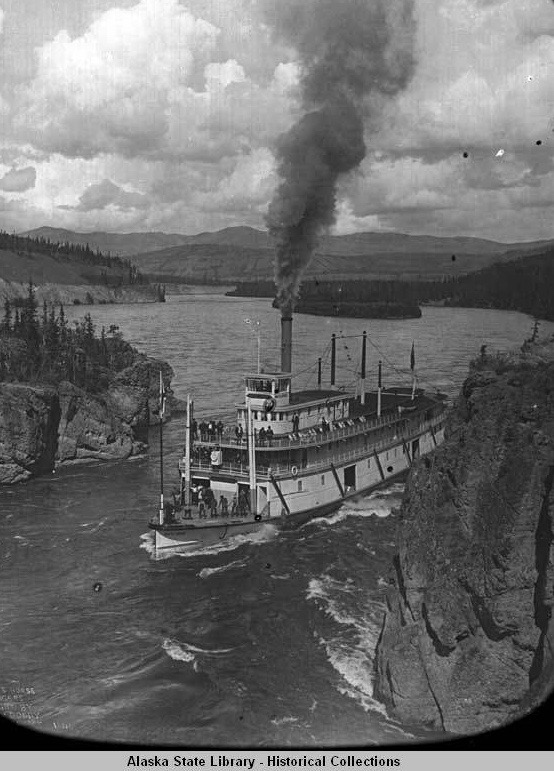
STR White Horse in Five Fingers Rapids, YT, circa 1904; Photo by Hamacher & Doody
The sternwheeler White Horse was built in 1901, and ran the Yukon River for 54 years. She had a length of 167 feet, a beam of 34.5 feet, and a gross tonnage of 986.65 tons. She accommodated 64 people.
The White Horse had an interesting history. Declared a “plague ship” in 1902, due to a 2nd Class passenger being suspected of having small pox. The sternwheeler was quarantined for 16 days, and the disease did not appear, so she returned to service.
In 1935, the White Horse was sent to rescue the passengers of the STR Yukon, which had been severely damaged by ice on the infamous Lake Labarge. Aircraft from the British Yukon Navigation Company, guided the White Horse through the ice to the beached Yukon.
In 1916, the White Horse took her first venture into the pure tourist trade, by making one of many Midnight Sun runs to Fort Yukon. The trips were a huge hit at the time.
The STR’s Casca & White Horse
The once proud White Horse came to a fiery end. She was passed up for restoration in 1955 in favor of the STR Klondike, which can still be seen in Whitehorse, YT. She was sold in 1960 along with the STR Casca and two other ships to the Canadian Government, but no restoration was attempted, other than to put them behind a chain link fence.
On 20 June 1974, both the White Horse & Casca caught fire in dry dock, and burned down to the gravel bed. No cause of the fire has ever been officially stated.
The sternwheeler White Horse
Sources: Alaska State Library, University of Alaska, CBC.CA
“What can we learn about ourselves looking back in time”?
A short film that came out recently inspired by the story of Ada Blackjack. The 6-1/2 minuet short, was filmed and produced in Alaska. Based, in part, on the biography Ada Blackjack: A True Story of Survival in the Arctic, by Jennifer Niven.