
Film Friday:

Camera: Leica M3; Film: Kodak 35mm, TMax100
Film Friday:
Camera: Leica M3; Film: Kodak 35mm, TMax100
Flashback Film Friday:
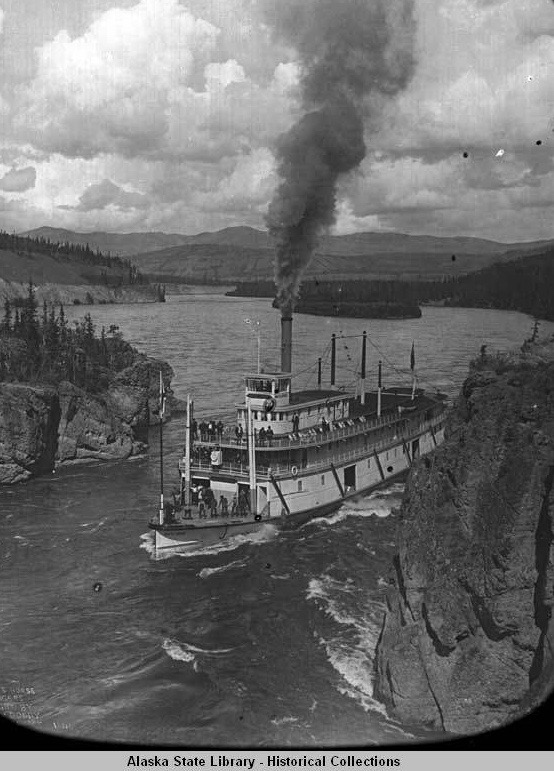
The sternwheeler White Horse was built in 1901, and ran the Yukon River for 54 years. She had a length of 167 feet, a beam of 34.5 feet, and a gross tonnage of 986.65 tons. She accommodated 64 people.
The White Horse had an interesting history. Declared a “plague ship” in 1902, due to a 2nd Class passenger being suspected of having small pox. The sternwheeler was quarantined for 16 days, and the disease did not appear, so she returned to service.
In 1935, the White Horse was sent to rescue the passengers of the STR Yukon, which had been severely damaged by ice on the infamous Lake Labarge. Aircraft from the British Yukon Navigation Company, guided the White Horse through the ice to the beached Yukon.
In 1916, the White Horse took her first venture into the pure tourist trade, by making one of many Midnight Sun runs to Fort Yukon. The trips were a huge hit at the time.

The once proud White Horse came to a fiery end. She was passed up for restoration in 1955 in favor of the STR Klondike, which can still be seen in Whitehorse, YT. She was sold in 1960 along with the STR Casca and two other ships to the Canadian Government, but no restoration was attempted, other than to put them behind a chain link fence.
On 20 June 1974, both the White Horse & Casca caught fire in dry dock, and burned down to the gravel bed. No cause of the fire has ever been officially stated.

Sources: Alaska State Library, University of Alaska, CBC.CA
Film Friday:

Camera: Rolleiflex 3.5MX; Film: Kodak 120, Tri-X400
Film Friday:

The weather gurus have told us to expect temps to drop below 0F the past few nights, but the expected mercury drop has not occurred. One night, I stoked up a nice fire in the stove, and ended up opening windows.
Now the low temps being forecast are back up into the upper teens. The below zero weather will arrive, but we’ve received a bit of a reprieve.
Camera: Minolta SRT201; Film: Kodak T-Max400
Film Friday:

Camera: Minolta SRT201; Film: Kodak 35mm, Tri-X400

It is a conscious decision on my part to keep the politics to a minimum, here between The Circles. Whether that is good or bad is open to interpretation, and we will keep that discussion for another time.
Recently, however, a nasty debate has been growing in Fairbanks. The debate has divided families, and wedged itself between friends. Today, I feel obligated to throw in my two cents.
The question: Now that we are into mid-October, are you excited to see snow?
When I say that people in Fairbanks are passionate about this question, I am not exaggerating.
Since we have not seen so much as a flake, other than the residents, the question is getting asked more & more. On average, our first snowfall occurs on September 22. Only twice since record keeping began, have we had a later first snowfall than today. October 16, 1911 & October 20, 2018. The current forecast remains snow free.
Snowshoes, skis, snowmachines and dog sleds all remain off to the side, in limbo, and dead grass.
Many are desperately anxious to see some powder. I think it’s safe to say that an equal number of people are thrilled with the idea of a Brown Halloween.
The Interior is divided. The tension thick. Personally, I’m just going where the Chinooks send me.
Camera: Minolta SRT201; Film: Kodak 35mm, Tri-X400
U.S. – Dakota War of 1862; Part XI

On August 17, 1862, four young Dakota warriors killed five settlers near Acton, Minnesota. The killings would ignite the war between the Dakotas’ and the United States military, but tensions had been brewing long before that August day in 1862. The bodies of those five settlers would be brought, to what is now Litchfield, and buried at Ness Church.
I visited the church and the surrounding cemetery with one of C-to-C’s sponsors, when I was back in Minnesota this past spring.

In the back corner of the cemetery, close to the rows of corn, stands a monument. Buried underneath, in one grave, are the first five victims of the U.S. -Dakota War: Robinson Jones, Viranus Webster, Howard Baker, Ann (Baker) Jones, and Clara Wilson.
The Ness Monument was erected on 13 September 1878, by the State of Minnesota. It is the third oldest monument in the state.

In 1970, the church & cemetery were listed officially, as a Minnesota Historical Site.
The church was founded by Ole Halverson Ness and his wife Margit, who arrived in the area in 1856. Ole Ness was a member of the Acton burial party.
Also buried in the cemetery is Andreas Olson, another victim of the U.S. -Dakota War. Olson was killed on 22 September 1862.

The current church was built by settlers in 1874, a dozen years after the start of the U.S. – Dakota War. The church is said to be haunted by both Sioux Indians and the five settlers, in particular the young girl, Annie. The church historical society denies any haunting, although that has not stopped self-proclaimed ghost hunters from breaking into the church.
I witnessed no paranormal activity when I was there, but I did find the cemetery to be a very solemn place.

Camera for B&W photos: Kodak 66; Film: Kodak 120, Tri-X400
Film Friday:


Camera: Kodak 66; Film: Kodak 120, Tri-X 400


