Tag Archives: Seward

The Harding Railcar


President Harding in Alaska on the presidential train

In 1923, Warren G. Harding became the first president to visit the Alaska Territory. Harding traveled by rail across the continental United States, then by ship to Seward, Alaska. The entourage traveled by rail once again to, what was then known as McKinley Park (Denali), followed by the short run north to Fairbanks. At the time, it was one of the longest trips ever taken by a sitting U.S. president.


President Harding driving the golden spike in Nenana. Commerce Secretary Herbert Hoover is one of the onlookers.

While in Alaska, Harding helped celebrate the completion of the Alaska Railroad, which runs between Seward and Fairbanks. Harding even drove in the “golden spike” at the stop in Nenana. Upon arrival in Fairbanks, city dignitaries were told that no Ford vehicles could be used in the motorcade. Speculation ran wild, but most likely it was due to rumors that Henry Ford may mount a presidential run himself.
President Harding gave a speech to 1500 Fairbanks residents in 94 degree heat. A reporter, Charlie Ross, who later served as press secretary to Harry Truman, cursed the White House staffers who advised the press to bring only warm clothing and long underwear.* It was Alaska, after all.

Harding and Company were originally scheduled to take the Richardson Trail back to Chitina, and then the Copper River & Northwestern (CR&NW) Railroad over to Cordova on Alaska’s southern coast.
Now that would have been a trip to write home about!
The Richardson at the time, was an unruly, rugged, mosquito infested track by all accounts, and the railway was affectionately known as “The Can’t Run & Never Will”. Sadly for history and adventure lovers everywhere, Harding’s “fatigue” forced the group to travel back to Seward they way they had come.


The Harding Railcar

One railcar from President Harding’s 1923 visit is located within Fairbanks’ Pioneer Park. It is a Pullman passenger car, and one of three that was in the presidential train. Built in 1905 in Chicago, the Pullman is also known as the Denali car, and carries the Alaska Railroad equipment number X-336. Purchased by the Alaska Railroad in 1923, it saw passenger service until 1945. It was restored in 1960 and given to the city of Fairbanks. It has been in Alaskaland/Pioneer Park since 1967.


The Denali Car

*The Anchorage Daily News


William H. Seward House

The Seward House

Built in 1816 by the future father in law of William Seward, the Seward House is now a museum.

William H. Seward

William Seward was the governor of New York State, a U.S. senator for New York, and probably best known as the U.S. Secretary of State as a member of Abraham Lincoln’s “team of rivals”.

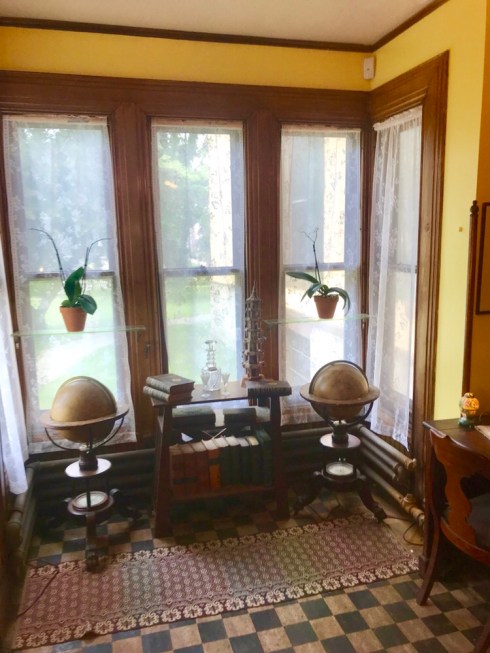
The Seward library

Seward led a fascinating life. He was not a big man in stature, but he was certainly a bold man who dominated the politics of his era.

Leave your sword with the bear at the door.

Seward lost to Lincoln in the presidential election of 1860, but then became Lincoln’s Secretary of State.

Painting depicting the signing of the purchase of the Alaska Territory

We took the tour of the house, led by a volunteer guide. It’s well worth the hour it takes to conclude the tour. The price was $10 with the AAA card.

The House holds a lot of Seward family heirlooms. William Seward took the home over from his father in law, and Seward’s son followed him, and his grandson took over the home from there. William H. Seward III donated the house to the foundation.

The purchase of Alaska is prominently displayed throughout the tour. One member of our party tried to get the woman at the desk to let me look through the photo album in the glass case. She politely declined.

There is a Native Alaskan kayak displayed from the ceiling in the carriage house. The kayak was given to Seward during his visit to Alaska in 1869.

A parlor in the house. Seward passed away while lying on the couch in the picture, although the couch was in another room at the time of his death.

Seward’s office, which is the room the former Secretary of State died in.


Benny Benson Memorial

Seward, Alaska

Just off of the Seward Highway, across from the Seward Lagoon, is the little memorial to Benny Benson. As posted prior, a 13 year old Benson, won a state-wide contest for his design of the Alaska State Flag.

lag.

It’s a nice, simple tribute to the state’s flag designer. Which seems fitting, considering the simple, yet elegant design of the state flag.


Harbor Life

Seward, Alaska


Camera: Leica M3; Film: Kodak 35mm, T-Max 100


Heading out of Resurrection Bay


Fort Raymond

Seward, Alaska


Fort Raymond, circa 1941

Fort Raymond was activated on 1 July 1941, with the purpose of protecting the rail terminus and the ice-free port of Seward, leading up to WWII. The fort was named after Captain Charles W. Raymond, a member of the U.S. Army Corps of Engineers. Captain Raymond had been sent to Alaska in 1869, to determine the precise location of Fort Yukon. When he confirmed that Fort Yukon was indeed within the Territory of Alaska, Raymond evicted the famed Hudson Bay Company from the region.


Fort Raymond historical marker

At its peak, Fort Raymond housed over 170 officers and 3200 enlisted men. In 1940, the civilian population of Seward was only 949.

On 25 March 1942, a Japanese submarine was spotted in Resurrection Bay, only 2000 yards from the Army dock. By June of that year, Japanese troops had taken the islands of Kiska and Attu in the Aleutian Chain, and Dutch Harbor had been bombed.

But by the fall of 1943, the Japanese had been forced out of the Aleutians, and the threat to Alaska had decreased substantially. In November of 1944, the fort went into caretaking status.

——————————————————————————————————

In 1946, the hospital at Fort Seward was renovated into a sanatorium for Alaska native children with tuberculosis. The sanatorium was open for 12 years.

The 1964 Good Friday Earthquake wiped out much of the town of Seward, including what remained of Fort Raymond. Several buildings from the fort can still be seen in Seward, however. Many quonset huts are scattered about the town, that came from Fort Raymond. The NCO building had been built out of local logs. That building is also still in use; it is the bottom half of the local American Legion post.

Today, the Seward Military Resort is located on the land that Fort Raymond once stood on.


Fishing Resurrection Bay

For the second consecutive year, we had incredible weather for our fishing trip out of Seward. Unfortunately, we did not catch as many silvers as last year. We knew we were a bit early for the coho run, but my buddy started a new job this spring, and he lost his time-off flexibility. Still, we did okay on cohos, and we did extremely well catching rockfish. There are 102 known species of rockfish, with 30 of them in the Gulf of Alaska. We caught several yelloweye rockfish, which are bright orange in color, and a couple of tiger rockfish, which are orange with black stripes.

I should stress the reality, that weather like this is extremely rare, and welcome, in the Seward area. To the left of the above photo is Bear Glacier, which the deck hand said hadn’t been visible for two weeks.

Once we started to get bait ready, the seagulls magically appeared. The deck hand threw several herring scraps up in the air, for the seagulls to catch. That action not only increased their numbers, but their aggressiveness too.

The ride out to the fishing area was to be 45 minutes, but wildlife viewing increased that time frame. We saw otters galore, as well as a group of sea lions in the above pic. There were about a dozen sea lions dozing in the sun, along this small island’s shoreline.

We also came across two orcas in the Bay. One adult, probably the mother, and her calf. It’s not a good pic, with the boat rocking, and the zoom way up. The fin of one of the orcas, and the water vapor from its blowhole is just visible in the center of the frame. The initial sighting was as close as they came to the boat. At one point, my buddy said, “You know they are going to pop up on the other side.” Sure enough, the two orcas did resurface off the opposite deck. At this point, I finally relented and pulled my phone out of my waterproof pocket, to catch this final glimpse of the orca. My apologies for being slow, but I had cohos on my mind.


Seward Harbor


The Gateway to Kenai Fjords

Back from our fishing trip to Seward, Alaska. Here are just a few of the Seward Sights:

Upon arrival, we hit the beach in late afternoon to wet our lines. This seagull watched patiently, hoping we would eventually catch it a salmon dinner.

Apparently, Seward is the Mural Capital of Alaska, a tidbit that had eluded me up until this past week. This one graces the wall of The Fish House, which is a great place to pick up any gear that one leaves in Fairbanks. It is also a pretty kick-ass hardware store.

Seward is the southern terminus for the Alaska Railroad. Across the street from the little depot, is one of the best breakfast places in town, called The Smoke Shack. This small diner is located in a complex known as The Train Rec. Made up of several retired Alaska Railroad cars, The Train Rec has a great view of the harbor.


The Train Rec complex


Eight stars of gold on a field of blue


The Alaska state flag

In 1927, when Alaska was still a U.S. Territory, Territorial Governor George Parks persuaded the Alaska American Legion to hold a competition. The Governor thought it would help the statehood movement by having a state flag, so the Legion held a contest, open to all Alaskan children, to design Alaska’s new flag.

142 designs were sent to Juneau from all over the state. A thirteen year old living in Seward, John Ben “Benny” Benson won the contest with a simple, yet elegant design.


Benny Benson holding his design for the new Alaska flag

Benny Benson was born in the fishing village of Chignik. His father was a Swedish fisherman, his mother an Aleut-Russian. Benny’s mother died when he was just three, and the family home burned to the ground shortly afterwards. His father, John Ben Benson Sr, could not take care of his three children alone, so they were divided up. Benny and his brother were put into an orphanage in Unalaska; his sister Elsie was sent to a school in Oregon.

The Jesse Lee Home in Unalaska was home to hundreds of Aleut orphans. It eventually moved from Unalaska in the Aleutian Chain, to the town of Seward on the mainland. It was from here that Benny Benson sent his design for the Alaska flag, as a seventh grader.


The Jesse Lee Home for Children in Unalaska, circa 1901

Benson described his design to the judges this way: “The blue field is for the Alaska sky and the forget-me-not, an Alaska flower. The North Star is for the future of the state of Alaska, the most northerly in the Union. The dipper is for the Great Bear – symbolizing strength.”

The Territorial Legislature approved the new flag in May of 1927, and Alaska officially flew its new flag for the first time on 9 July 1927. Benny Benson received a watch, with the flag design etched on it, as well as a $1000 educational scholarship, which he eventually used to become a diesel mechanic.

Benson Boulevard in Anchorage, which is a major east-west thoroughfare, is named after Benny.
A Benny Benson Memorial is located at milepost 1.4 of the Seward Highway in Seward.
The airport in Kodiak was renamed the Kodiak Benny Benson State Airport in 2013.
A school in Anchorage on Campbell Airstrip Road has been named the Benny Benson School.

Benny Benson died of a heart attack in 1972. He was 58.

The black & white photos courtesy of The Alaska State Library Archives