

Monthly Archives: August 2018
Custer National Cemetery
Bighorn County, Montana

Custer National Cemetery
These are from a past Rover Roadtrip.
Big Sky Country.
The head stones, just like the plains of Montana, seem to go on forever.

I remember it was a hot, dry, spring day, on this visit to the Little Bighorn Battlefield.

Indian Memorial Sculpture at Little Bighorn
Camera: Kodak 66; Film: Kodak 120 T-Max 100

USS Abner Read

USS Abner Read
The U.S. destroyer, Abner Read, struck a Japanese mine off the coast of Kiska Island on the 18 August 1943 during the Battle of Kiska. The explosion tore off the ship’s stern. There were over 300 men on board the Abner Read that day, many were in their bunks in the stern when the mine blew at approximately 1:50am. 71 sailors died, but 20 were hauled out of the frigid Bering Sea waters.

The Abner Read after the explosion off the coast of Kiska
The crew was able to keep the destroyer afloat. The ship was shored up as best they could, the main compartment was kept water tight, and a homemade rudder was attached. Two U.S. Navy ships then towed the Abner Read to port.
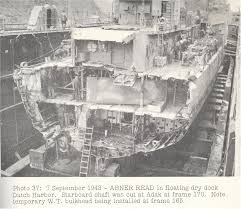
The Abner Read in floating dry dock
Within months, the Abner Read had its stern repaired, and the destroyer rejoined the war.
———————————————————————————————–
In July of this year, a research team funded by NOAA, discovered the Abner Read’s stern off the coast of Kiska Island. It’s general location has been known, and the team of scientists from the Scripps Institution of Oceanography at the University of California San Diego and the University of Delaware used multi beam sonar to locate the wreckage. They then sent a remote operated submersible down to the stern, which was in 290 feet of water.

Photo credit: NOAA
The stern section measures 75 feet long and 18 feet high, and is now covered in marine life.

Gun on Abner Read stern section; Photo credit: NOAA
Daryl Weathers was a 19 year old seaman on the Abner Read. He is the last known survivor from the destroyer on that August day in 1943. Weathers is 94 now, and lives in Seal Beach, California. When told that the stern section had been found, Weathers expressed surprise saying, “That’s the end of the world up there.”
————————————————————————————————
For its wartime service, the Abner Read received four battle stars from the Pacific Theater. In November of 1944, during the Battle of Leyte Gulf, the Japanese launched a kamikaze attack. A Japanese dive bomber (VAL) made it through the anti aircraft fire, although it had been hit. The bomber was able to drop one of its bombs down the destroyer’s smokestack, blowing up the engine room. The VAL then crashed across the main deck, setting it in flames. The Abner Read sank within hours.

The Abner Read is struck by a kamikaze attack in November 1944
The Queen of Soul

Aretha Franklin at Columbia Records
We lost another icon of the music world with the passing of Aretha Franklin. Franklin got her start as a child singing gospel at the New Bethel Baptist church in Detroit, where her father was a minister.
Franklin signed on with Columbia Records in 1960 at the age of 18. She found success and acclaim after signing with Atlantic Records in 1967. By the end of the 1960’s Aretha had become the Queen of Soul.
Franklin brings down the house at the Kennedy Center Honors in 2015. As a singer, Franklin won’t drop the mic, but she can drop the coat.
I have to add a clip of Aretha’s cameo in “The Blues Brothers”. Matt “Guitar” Murphy is “her man” in the film. Sadly, we lost Murphy earlier this year, as well.
Franklin was a powerful vocalist, who wrenched every bit of emotion out of the lyrics. As Paul McCartney said, she “was the Queen of our souls.”
Aretha Franklin was 76; there will never be another quite like her. Rest in peace.
Fireweed Omen

For anyone who has spent at least a year in the north, this comic needs no explanation.
For those who have not: WINTER IS COMING
Comic credit: Jamie Smith and Nuggets
Battle of Kiska
Operation Cottage:
15 August 1943
75 Years Ago

Kiska Island on the Aleutian Chain
The Japanese had occupied Kiska Island on Alaska’s Aleutian Chain since June of ’42. After the brutal Battle of Attu, Allied forces expected the same type of defense of Kiska from the Japanese.

Japanese Type A mini submarines on Kiska Island
Leading up to the invasion, the U.S. Air Force bombarded the Japanese positions on Kiska. In June of ’43, 407 bombing sorties were sent to the remote island, and even more in July. Japanese troop level was at just over 5100 men. Resupply of the island had become by submarine only.

Japanese tunnel to the beach
In August, bombing sorties increased even more. On August 4 alone, 135 sorties dropped 304,000 pounds of explosives on Kiska.* No Japanese troops were sighted by the bomber pilots, but that was not unusual, since the Japanese went underground during the raids.

Allied troops landing on Kiska Island
7300 combat troops landed at the main beach head. They were greeted by six dogs wagging their tails. One of the dogs was “Explosion”, the pup that was with the Navy weather station crew that was on Kiska when the Japanese invaded the island the previous June. In all, 34,426 Allied troops were a part of the invasion, which included 5300 Canadians.
As troops moved across the foggy island, occasionally a bomb or booby trap was set off, but no enemy soldiers were to be seen. Still, shots were fired into the fog by the jumpy soldiers.
The Japanese were no longer on the island. Realizing they could not defend Kiska after losing Attu, they had evacuated the island two weeks before the invasion.
92 Allied troops were killed, and 221 wounded. Most came when the destroyer Abner Read struck a Japanese mine causing 118 casualties. 4 Canadians and 17 Americans were killed on Kiska, and 50 were wounded, many by friendly fire in the fog. 130 men suffered from trenchfoot, of which only one was a Canadian due to their proper footwear.

Guns of Kiska
The Americans would not learn how or when the Japanese evacuated the island until after the war ended.

The Japanese Type A midget sub on Kiska today
Today, Kiska is part of the Aleutian Islands Wilderness, and the Japanese occupation site a National Historic Landmark.

The Navy Weather station crew on Kiska prior to invasion. Explosion is front and center.
*The Thousand Mile War
Photos courtesy of The Alaska State Library

The Nenana River

Nenana River
The 140 mile long Nenana River forms the eastern boundary of Denali National Park. This tributary of the Tanana River, is a popular white water rafting destination. The Nenana begins as a Class I, but turns into a Class IV in the Nenana Gorge.

Thunder Mountain Crash

A de Havilland Beaver (DHC-2), flying out of Talkeetna on a flight seeing tour of Denali National Park, tragically crashed near the summit of Thunder Mountain on August 4. The crash site is roughly 14 miles from Denali’s peak.
There were four tourists from Poland on board, as well as the pilot. Initially, word spread that several people on board survived the crash, but that is not the case. All five in the de Havilland perished.
Heavy cloud cover hampered efforts to reach the site in the days right after the crash. The National Park Service eventually was able to send out two crews in helicopters. The first was to check for survivors, and the second was to evaluate the scene for possible recovery. Park rangers were dropped by cable to the broken Beaver, which lay precariously on the mountain side.

After accessing the risk, The National Park Service came to the conclusion Friday, that any attempt to recover the five bodies in the plane would put the rescue crews in too much danger. One look at the photos show why. The Beaver is broken behind the wing, and the tail section is pulling the entire plane down. It’s a 3500 foot drop to the glacier below. Since the crash, 30 inches of snow has fallen, driving up the risk of avalanche.
On Friday, I spent some time downtown, and overheard several tourists complain about the NPS decision. I get why they thought that way, but I respectfully disagree. The risk to a recovery crew would be too great, and as tough as it is to hear it, NPS made the right call.
Photos credit: Denali National Park & Preserve
Creative Commons

Circle to Circle is licensed under a Creative Commons Attribution-NonCommercial-NoDerivs 3.0 Unported License.Like the Stories & Photos? Help Keep the Rover Rolling.
