As we slide into the Dark Abyss that is winter, there is one phenomenon that makes up for our shortened days: The Northern Lights.
With a geomagnetic storm in progress, and a forecast of clear skies, the first aurora of the season may be visible over the cabin in the next few days.
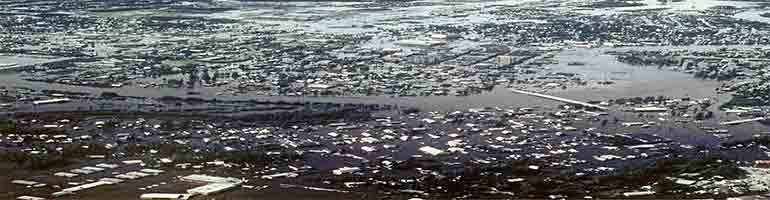
Aerial photo of Fairbanks after the Chena River overflowed its banks
This week is the 55th Anniversary of the Great Flood of 1967 that hit Fairbanks. The first half of August that year saw near continuous rainfall, that eventually was too much for the Chena and Tanana Rivers to hold back.
Downtown Fairbanks in August of 1967
At its peak, 95% of Fairbanks was under water. Over 6000 homes and businesses were a total loss, and as many sustained damage. Eight people lost their lives due to the flooding.
On Saturday at Pioneer Park, the Borough will celebrate SS Nenana Day, to honor the Last Lady of the River.
The SS Nenana steamed the waters of the Yukon and Tanana Rivers between 1933 and 1954. It was officially retired in 1957, and has been a museum ship since 1965.
The SS Nenana; Photo credit: Fairbanks North Star Borough
The Nenana is one of only three steam-powered passenger sternwheelers left in the U.S. and the only large wooden steamer to survive the years.
Inside the Nenana’s wheelhouse
The Nenana has been neglected, restored, and then neglected once again. Efforts, including today’s celebration at Pioneer Park, are underway to try to stabilize, and hopefully restore the Last Lady of the Yukon.
The period of civil twilight+ came to an end in Fairbanks late last week. It was a run of 75 days of constant light. Basically, one can do anything outside without the use of artificial lights during civil twilight. Including baseball games!
The Tanana Valley State Fair starts up on Friday and runs through August 7th. It’s a Fairbanks favorite, and people seem to be raring to get out and go. I’ll be curious if attendance numbers get up to pre-Covid levels.
For the first time in decades, the fair will not feature any poultry in the 4H Barn, due to avian flu concerns. The fairgrounds are near the Creamer’s Field Migratory Waterfowl Refuge, which has documented cases of avian flu.
This year’s fair theme: Sheepherder in Paradise
This year’s featured flower: Sunflower
And the featured fruit/vegetable is a fan favorite: Pumpkin
A new tourism study released by the University of Alaska Fairbanks turned a few heads recently. The group of tourists that spend the most money and stay the longest in Alaska are birdwatchers. In fact, birders spend twice as much time in Alaska when they visit than the non-birders do. In 2016, birdwatchers spent over $300 million in Alaska.
The study probably shouldn’t have surprised as many people as it did. Alaska is a birdwatching mecca. Alaska is home to the largest concentration of shore birds in the world. There are some 530 species of birds that have been documented in Alaska, 55 of which are considered rare.
So, if you want to see a red-breasted sapsucker, I suggest the rainforest of Southeast Alaska. As for Fairbanks, we have a very active and vocal raven population.
Early SeptemberLate SeptemberEarly NovemberStart of the Solstice StormA bit snowy Winter Solstice afternoonEvening on the Winter SolsticeSnow packed lensLens starting to break free of ice and snowLate January visitorFebruary; The sun begins to return, and moose tracks
The months of May and June in 2022 were the driest, statewide, on record. The period of January through June was the fifth warmest on record. Amazing, considering the staggering amount of snow we had, up to New Year’s. The tap was simply shut off.
The Clear Fire; Photo credit: Alaska Fire Service
So far in the 2022 fire season, Alaska has seen 2.74 million acres burn. The Clear Fire, near Anderson, Alaska and the Clear Air Force Base, is now pushing 70,000 acres and is right up to the Space Force Base boundaries. It is one of three fires that account for most of the smoke driven towards Fairbanks.
Fires over 50,000 acres; Map credit: Alaska Fire Service
With the 2.74 million acres burned, we have passed the entire 2019 fire season, and 2022 is already the 8th largest season in acres burned.
Water drop over the Clear Fire; Photo credit: Alaska Fire Service
I included the final photo simply because I love the image. Kudos to the Fire Service Photographer who captured it.