
Film Friday:

Camera: Kodak 66; Film: Kodak 120, Ektar 100
A Pandemic Roadtrip: Part Six

Mile Marker 585
The Yukon; finally I was in the Yukon Territory. I have nothing against B.C., but now Alaska is in the sights.

The AlCan is not fully paved
Don’t let anyone fool you, the Alaska Highway is not completely paved. It’s close, but it’s not complete. The Yukon always has sections that are gravel, and the sections go on for miles. It can be a bit dusty, especially when a semi truck is in front of you.

Muncho Lake
I admit the gravel travel is worth it once you come across Muncho Lake. The jade colored waters light up even on a dreary day. “Muncho” in the Kaska language translates to “big water”, and it is that,

Kluane Lake
Kluane Lake is the largest lake within the Yukon, that lies entirely within its borders. It’s a huge lake, and in normal years there is a visitor’s center that is worth a stop. This year, due to Covid-19, it was closed.

Another river to cross, but we’re getting closer
There were many businesses and sights closed to the public along the entire route. Places that I have historically stopped at for food or gas, were closed. Laird Hotsprings, a very popular natural swimming hole and gathering place, was completely shut down. For much of the route through northern British Columbia and across the Yukon, there were signs out on the road frontage thanking truckers. After a while, it made total sense. There is no one else driving these roads; just the truck drivers. One place I stopped at, near the Alaska border, there was a sign out front, and I did ask the owner about it. He told me that the truckers were the only reason he was open and able to stay afloat. No tourists, and only a few Alaskans like me, trying to get home.
Final stop for the night: Haines Junction, YT
Connecting Generations through ice & snow:

After the assassination of John F. Kennedy, the people of Canada wanted to honor the slain president. In November 1964, the Canadian government, following the suggestion of famed mountaineer, photographer and cartographer, Bradford Washburn, elected to name an unclimbed peak in the St Elias Mountain Range, Mount Kennedy.

RFK on Mount Kennedy
The mountain lies 145 miles from Whitehorse, YT, within Kluane National Park, and less than 10 miles from the Alaska panhandle. Mount Kennedy forms a triangle with Mount Alverstone and Mount Hubbard. At the time of the dedication, the mountain was the tallest (13,944 ft) unclimbed peak in the St Elias range.
National Geographic put together a team to make the first ascent of Mount Kennedy in 1965. The team was led by Jim Whittaker, who had been the first American to climb Mount Everest, and was made up of mostly experienced mountaineers. Also making the climb: Bobby Kennedy, to honor his fallen brother.

Jim Whittaker & Robert Kennedy on the summit
On 24 March 1965, the climbers made for the summit. This was Kennedy’s first taste of mountaineering. To add to the tension, RFK was no fan of heights. The other climbers insisted that politics was far more dangerous than climbing mountains, which would prove prophetic.
Crossing the Cathedral Glacier, Kennedy fell into a crevasse. Luckily, it was a narrow one, and he only went in to the waist, and quickly scrambled out. The final run to the summit is the most risky, as the climber has to traverse a narrow ledge with a sheer one thousand foot drop.

Photos credit: Whitehorse Star
Jim Whittaker and Bobby Kennedy would become good friends on the climb, a friendship that would last until Kennedy’s death. Whittaker would name one of his sons after the U.S. Senator.
50 Years Later:

The Whittaker Brothers
Fifty years after the original ascent of Mount Kennedy, the two sons of Jim Whittaker wanted to honor their father and his friend Robert Kennedy. They decided to climb the mountain themselves.
Leif Whittaker is an experienced climber like his father, but Bobby Whittaker had more experience in Seattle’s Grunge Scene than summiting mountains. Christopher Kennedy, the son of RFK, would join the Whittakers on the expedition.
Return to Mount Kennedy is the documentary about the two ascents. The footage from the original climb is pretty impressive to see.
I saw a screening of the documentary prior to the Coronavirus outbreak. It was put on by REI, the outdoors store, which had Jim Whittaker as its early CEO.
The documentary is available on several streaming platforms. The original National Geographic story can be found in the July 1965 edition of the magazine.
Trailer: Return to Mount Kennedy
Alaska’s Big Five; Chapter Five:
Dall Sheep, Ovis Dalli dalli, can be found throughout Alaska’s mountain ranges. Dall Sheep prefer relatively dry country, their territory is the open alpine ridges, mountain meadows and steep slopes. They like to keep an extremely rugged “escape terrain” close at hand, and are not often found below tree line.
The rams are known for their massive curling horns. The ewes have shorter, more slender and less curved horns. The males live in groups and seldom interact with the females until breeding season, which is in December.
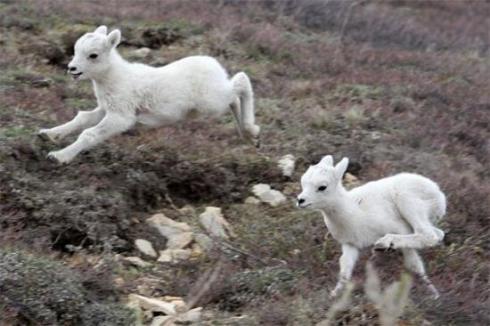
Lambs are born in late May to early June. Ewes usually reach breeding age at 3-4, and have one lamb each year after that. The lambs are most vulnerable during their first 30-45 days of life, and mortality rate is high during this time. Wolves, black & brown bears and golden eagles are the main predators.
Dall sheep horns grow steadily from early spring to late fall, but tend to slow, if not stop growing altogether, during the winter months. This leaves growth rings on the horns called annuli. These growth rings can help identify the age of Dall Sheep. In the wild, 12 years of age is considered old for a Dall Sheep, but rams have been identified as high as 16, and ewes up to 19 years of age. A Dall Sheep ram can weigh up to 300 pounds, with the ewes being about half that weight.
Between 1990 – 2010, Dall Sheep numbers had dropped by 21%, from 56,740 to 45,010. Numbers started increasing up until 2013, when a later than average snowfall put a damper on recovery efforts. Dry, heavy snow loads appear to have little effect on sheep population, but the heavy, wet snowfalls, with a frozen crust can make foraging and travel difficult. Freezing rain has also become more prevalent. All of these factors contribute to more avalanches, which have become a significant cause of death for Dall Sheep in the state.

Film Saturday:

Yukon Quest Start 2020
Camera: Leica M3; Film: Fujichrome 35mm, Velvia 100

A musher and dog team take the Chena River out of Fairbanks
The Yukon Quest Sled Dog Race started on Saturday morning. Fifteen teams left Fairbanks, with the goal of Whitehorse, Yukon Territory in 9 days, give or take.
It was a rather chilly morning to be hanging out on the Chena River to cheer the teams on their way, but several hundred people turned out to do just that. It was -25F when I left the cabin, and it must have been -30 down on the river ice. Everyone, including the dogs, were bundled up.
The 1000 mile race between Fairbanks and Whitehorse first started in 1984. A 1983 bull-session in the Bull’s Eye Saloon in Fairbanks, led to the race’s creation. Twenty-six teams left Fairbanks that first year. The winner, Sonny Linder, made it to Whitehorse in just over 12 days.
The Quest follows the historic gold rush routes between the Yukon and Alaska’s Interior, traveling frozen rivers and crossing four mountain ranges. Dawson City, YT is the half-way point. In even years, the race starts in Fairbanks, and in odd years the race starts in Whitehorse.
There are ten checkpoints and four dog drops, where dogs can be dropped off, but not replaced. Sleds can not be replaced without a penalty. The record run happened in 2010, when Hans Gatt finished in 9 days, 26 minutes. The slowest time happened in 1988, when Ty Halvorson completed the race in 20 days, 8 hours, 29 minutes.
Fairbanks, Alaska

Pioneer Air Museum
It had been several years since I ventured into the Air Museum at Pioneer Park. Since they were experimenting with winter hours, I decided it was time to head back over there and see what was new.

Under The Dome: Inside the Air Museum
The Pioneer Air Museum houses a fairly extensive collection of aircraft and other artifacts mainly pertaining to Interior Alaska and Arctic aviation.

Ben Eielson Display
The first major display is on Ben Eielson, the famed aviator and Alaskan bush pilot. Eielson learned to fly in WWI, with the U.S Army Signal Corps. After the war, a chance run-in with Alaska’s territorial delegate to Congress, led to Eielson heading to Alaska to teach. By 1923, Eielson had started the Farthest North Aviation Company. Eielson was the first to fly air mail in Alaska, and the first to fly from North America over the North Pole to Europe.
In 1929, Eielson and his mechanic died in a plane crash in Siberia. The cargo ship Nanuk was frozen in sea ice off North Cape, and Eielson was contracted by expedition leader Olaf Swenson to fly out personnel and furs. The plane crashed in a storm, cruising at full throttle into the terrain. A faulty altimeter is the suspected cause of the crash. Parts of Eielson’s recovered aircraft is on display at the museum.

1935 Stinson SR-JR
This bright red Stinson SR-JR, the Spirit of Barter Island, came to Alaska in 1940, and was flying the Interior out of Fairbanks in 1953 for Interior Airways.

The Stinson in artwork
This SR-JR carries four passengers, has a cruising speed of 110mph, and a range of 450 miles. It was an Interior workhorse, and well known in the Fairbanks area. The image, “I Follow Rivers”, can be found on t-shirts around Fairbanks to this day.

Stinson V77: Peter Pan
The Stinson V77 is the Navy version of the SR-10 Reliant. “Peter Pan” flew the Kuskokwim and Yukon River mail runs. The Stinson Reliant was a favorite of bush pilots, as the aircraft was equally at ease landing on wheels, skis or floats. In 1949, “Peter Pan” made the flight from Bethel, Alaska to Boston, Mass. It is back in Alaska, on loan to the museum, from the bush pilot’s family.

1943 P-39 Wreckage
The P-39 Airacobra was a common sight in Alaska’s Interior during WWII, as it was a mainstay of lend-lease aircraft to the Soviets. This P-39 only made it to Fairbanks in pieces, as it was involved in a mid-air collision with another aircraft 60 miles east of Fairbanks. Both pilots survived the crash.

1942 ST Type Ryan PT-22
The PT-22 was used for flight training all over the globe. Over 14,000 Air Corps pilots trained in the PT-22. This particular PT-22 came to Fairbanks in 1956 after it was retired out of the military.

The “Huey”
Manufactured by Bell Helicopter in 1966, this UH-1H “Huey”, saw combat in South Vietnam. During a mission in 1969, this UH-1H was hit by a rocket propelled grenade while landing. After the war, it came to Alaska, and was transferred around the Alaska Army bases, finally landing at Fort Wainwright in Fairbanks. It was retired in 1993, and is on loan to the museum from the U.S. Army. The “Huey” is still maintained by Army personnel.

Thomas Ackerman photo
A visitor to the museum several years ago, recognized the Huey’s ID number as the one he flew during the Vietnam War. Sgt Thomas Ackerman was a crew-chief and gunman on this UH-1H. He supplied several photos of the Huey, during its time in Vietnam, to the museum, including the one above. Thomas Ackerman died of Agent Orange related cancer in 2004.

Camera: Rolleiflex 3.5MX; Film: Kodak 120, TMax100
The Lend-Lease Monument is located in Griffin Park, downtown Fairbanks, near Golden Heart Plaza, alongside the Chena River.
The Lend-Lease Act was originally passed in March 1941, with the Soviet Union being added to the program in October of the same year. The Northwest Staging Route, from the mainland of the U.S. through Canada and into Alaska, was extended into the Soviet Union with the Alaska-Siberian Airway (ALSIB).

Map of ALSIB; cell phone photo
Planes were ferried from locations like Buffalo, NY; Minneapolis, MN; St Louis, MO; and Oklahoma City, OK to Great Falls, MT. Airfields were carved out of the wilderness from Montana through Canada and on to Ladd Field in Fairbanks. Most airfields were built 100 miles apart, with the longest being between Fort Nelson, BC and Liard River, which was 140 miles. The Alaska Highway would soon be completed linking the airfields together by road.

The first Soviet pilots landed in Nome on 14 August 1942. The Soviets took over the aircraft at either Ladd Field in Fairbanks or at Nome, then flew across the Bering Strait to Krasnoyarsk in Siberia.
Over 8000 aircraft flew through Ladd Field in Fairbanks on their way to the Soviet Union. Between October 1941 and the end of May 1945 the U.S. provided the USSR with nearly a half-million vehicles other than aircraft, 2 million tons of gasoline and oil, and close to 4.5 million tons of food. Of the 8000 aircraft, 133 were lost. The average time to ferry an aircraft to the Soviet Union was 33 days.
Some of the aircraft ferried:
The Bell P-39 Airacobra, followed by the P-63 Kingcobra its successor, the Curtiss P-40 Warhawk, and Rebublic P-47 Thunderbolt. Bombers ferried included the Douglas A-20 Havoc and North American’s B-25 Mitchell. Most of the transports ferried were the Douglas C-47 Skytrain.
“The structure of world peace cannot be the work of one man, or one party, or one nation… it must be a peace which rests on the cooperative effort of the whole world.”
—Franklin Delano Roosevelt

Map credit: National Weather Service & NOAA
Interior Alaska had a decent cold snap drop in for the Winter Solstice and Christmas holiday. From December 17-28, Fairbanks did not see temperatures climb above zero. By Alaska standards, the period was neither long nor extreme, but we did make some ice, as they say. For comparison sake: The 11 day streak of below zero is tied for 42nd longest in the past 50 years. *
The Koyukuk & Yukon River Valleys saw the largest drops, as Allakaket and Manley Hot Springs fell to -60F and -65F respectively. The Manley temp was the coldest officially recorded in Alaska since Fort Yukon dipped to -66F in 2012.
Fairbanks officially reached -40F for the first time this season on Dec 27. That was the only day it dropped down to -40 at the cabin, as well. We had not seen -40F in Fairbanks since January 12, 2019, which is quite the stretch for us.
On December 28, the Deadhorse airport combined -38F temperatures with a 21 mph breeze, to offer a -73 degree windchill to residents of Prudhoe Bay.
No record lows were set during the 11 day period. The record low statewide for the month of December is -72F, which happened in Chicken, Alaska on New Year’s Eve of 1999.
In spite of the cold snap, there is little doubt that 2019 will be the warmest on record for Alaska. Currently, the temp outside the cabin remains above zero, some birch logs are smoldering in the wood stove, and a window is open, as I type this out, dressed in shorts and a t-shirt.
Interior Cabin Life.
*@AlaskaWx


